Dermatology Signal Strategy 2026: For Applicants Without Ties, Signaling Lifts Invites 4.8x
We analyzed 20,304 Dermatology applicants across 139 programs. The headline: if you have no away rotation and no geographic tie to a program (the majority of applicants), your interview probability jumps from 8% to 39% when you signal. If you did an away rotation, signaling barely moves the dial because the away already gets you to 86%. Here is how to allocate your 28 signals.
TL;DR
- Signaling is functionally required to interview in Derm. At the median program, 0% of invitees did not signal. At 77% of programs, fewer than 1% of invitees were unsignaled.
- For the 84% of applicants without ties to a program: 8% invite rate unsignaled, 39% signaled (4.8x lift, +31 percentage points).
- For applicants with a geographic tie: 36% unsignaled, 54% signaled (1.5x).
- For applicants with an away rotation: 86% invite rate. Signaling does not add (CI is wide; n_signaled = 5).
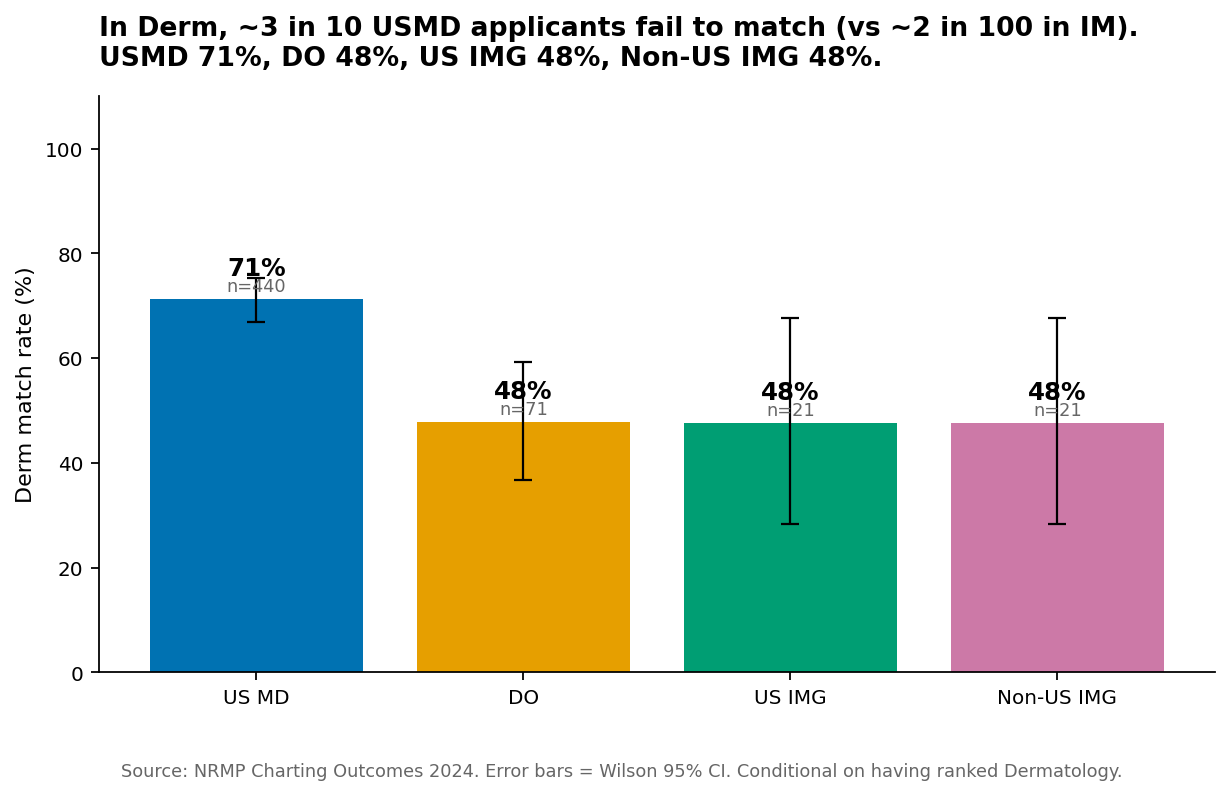
- Match rate by applicant type: US MD 71%, DO 48%, US IMG 48%, Non-US IMG 48%. Derm is one of the few specialties where ~3 in 10 USMDs fail to match.
- Top-Step-2 Derm programs invite 5% DOs vs 21% at bottom-quartile programs. Program selectivity sorts applicant types sharply.
Finding 1: Signaling lifts unfettered applicants 4.8x. Aways override it.
We classified 20,304 Dermatology applicants by whether they had ties to each program: no ties (no away rotation, no geographic connection), geo only (in-state school or geographic signal area), away only (did an away rotation at the program), or both. Within each cell we computed invite probability with and without a program signal.
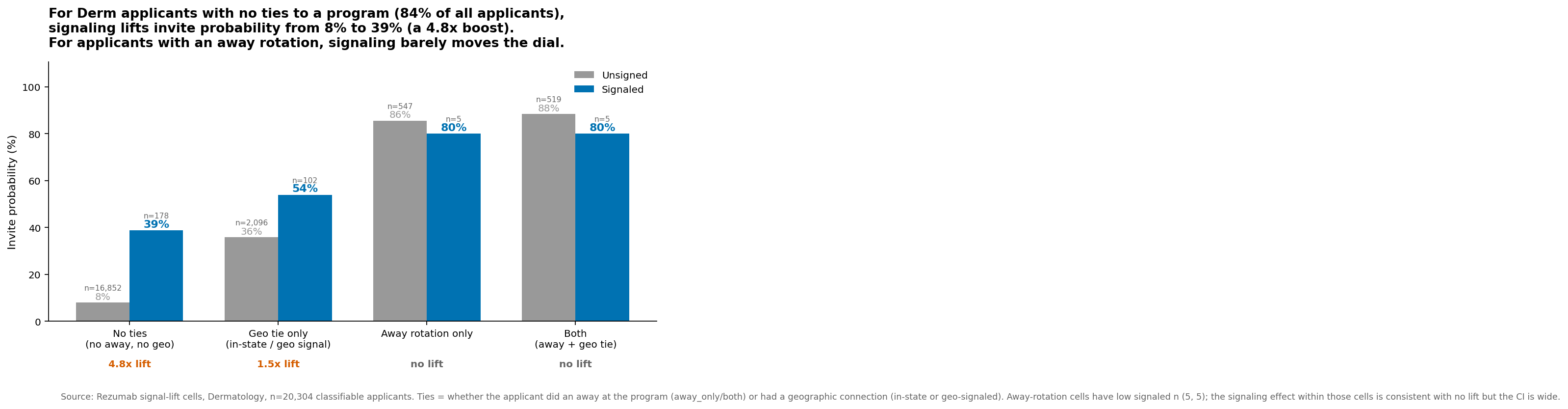
The asymmetry is structural. If you did an away rotation at a program, your interview probability is already 86% before you decide what to do with your signal. Burning a gold or silver signal on a program where you did an away is largely wasted, statistically speaking. But 84% of Derm applicants do not have an away at most programs. For them, signaling moves invite probability from 8% to 39%. That is the single largest leverage point in the entire Derm application.
Finding 2: Signal lift by Step 2 band
Stratifying applicants by Step 2 CK score and applicant type, the lift ratios are remarkably stable. MD applicants scoring 240-249 see the largest stratum-level lift at 3.9x. MDs scoring 260-269 see 3.2x. Across the dataset, the overall ratio is 2.92x. DO applicant counts within signaled cells are too sparse (n less than 10 in every band) to plot a reliable per-stratum ratio for DOs; the cells dataset (Finding 1) gives a cleaner read.
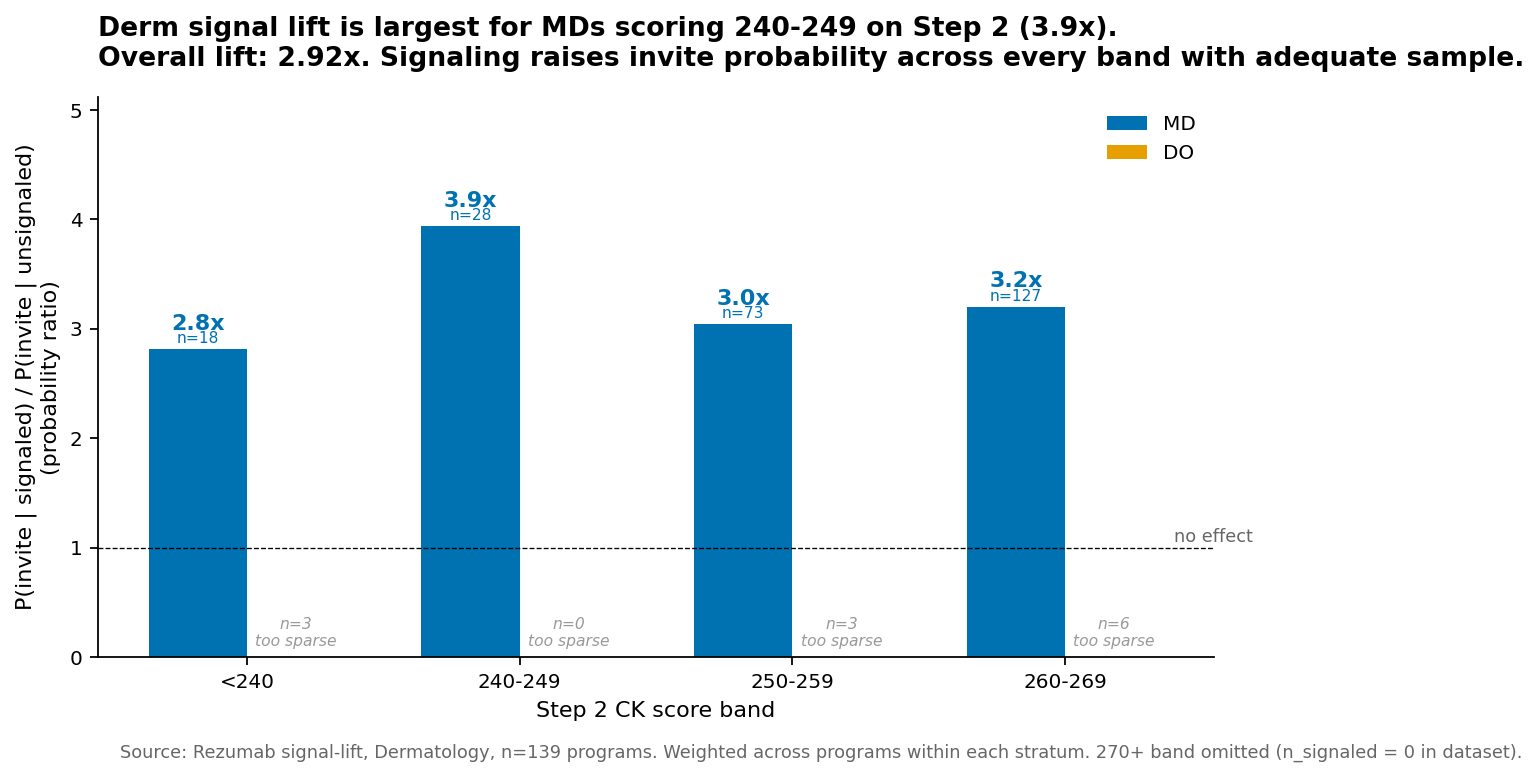
Note: these stratum-level lifts pool all applicants regardless of away rotation or geographic tie status. The Finding 1 ties breakdown is the more interpretable one for the typical applicant who is asking “what is my signal worth?”
Finding 3: Match rates by applicant type
Conditional on having ranked Dermatology, the NRMP 2024 match rates by applicant type are:
| Type | n applicants | Matched | Unmatched | Match rate | 95% CI |
|---|---|---|---|---|---|
| US MD | 440 | 314 | 126 | 71.4% | [67.0%, 75.4%] |
| DO | 71 | 34 | 37 | 47.9% | [36.7%, 59.3%] |
| US IMG | 21 | 10 | 11 | 47.6% | [28.3%, 67.6%] |
| Non-US IMG | 21 | 10 | 11 | 47.6% | [28.3%, 67.6%] |
Derm is one of the few specialties where roughly 3 in 10 USMDs who rank it fail to match. The ranked-into-the-specialty gate already filters out the least-competitive applicants, and the unmatched fraction is still 29%. For DOs and IMGs the figure is 52%.
Finding 4: Derm programs do not invite unsignaled applicants
Of 81 Dermatology programs that report the signal-status breakdown of their invitees, the median program had zero unsignaled invitees. At 77% of these programs, fewer than 1% of invitees were unsignaled. At 90% of programs, under 3% were unsignaled. The implication is blunt: in Derm, an unsignaled application is functionally not a candidate for interview at the typical program.
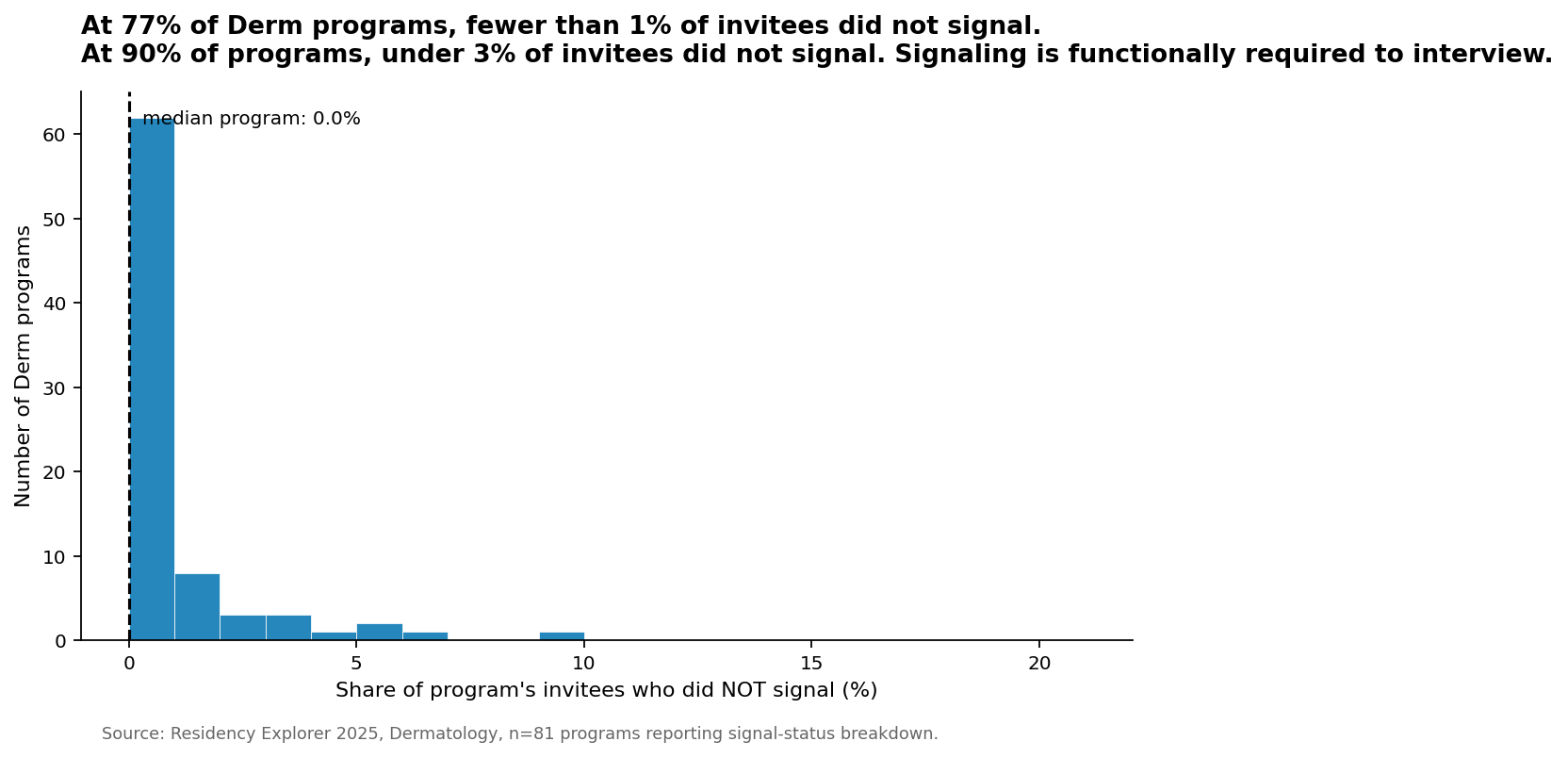
This is why signal allocation is the entire game in Dermatology. Derm allots 28 signals (3 gold + 25 silver) to each applicant. There are roughly 144 Derm programs. The math forces a triage: 28 of 144 programs (~19%) get a signal, the rest get nothing. Without a signal, the data says you are essentially not in the running at that program unless you have an away rotation or strong geographic ties.
You get 28 signals. Don't guess where to put them.
Rezumab's signal-strategy explorer ranks all 139 Derm programs by empirical lift for your Step 2 band, applicant type, and geographic ties. See which programs reward your signal most and which are essentially out of reach.
Open Derm signal strategy →Finding 5: USMDs are 80% of applicants and 85% of matches
The Dermatology applicant pool is heavily tilted toward US MDs. USMDs are 80% of all applicants, get 65% of invites at programs reporting type breakdown, and end up at 85% of Derm matched positions. DOs are 13% of applicants and 9% of matches. IMGs (US plus Non-US) are 8% of applicants and 6% of matches.
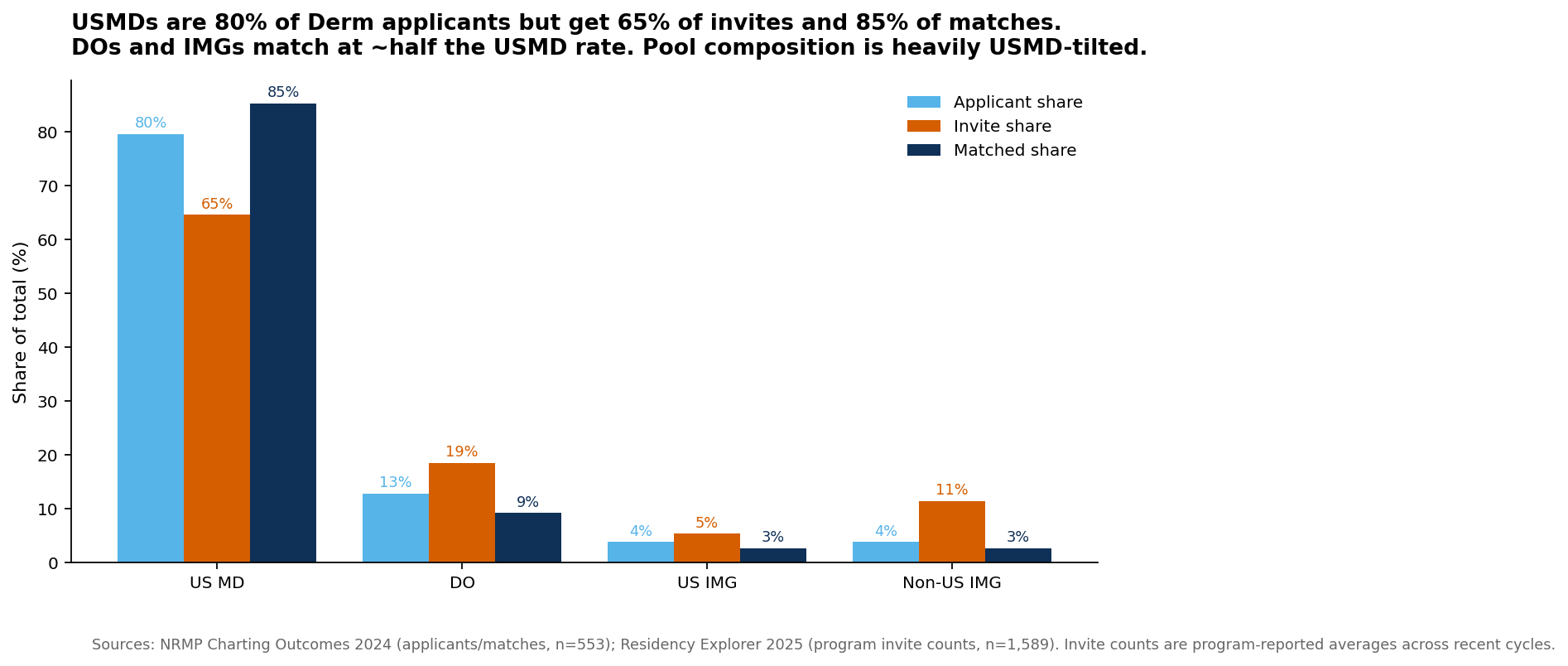
Notable: USMDs are over-represented in matches (85%) relative to invites (65%) because the conversion from invite to rank-to-match is higher for USMDs. DOs and IMGs receive a disproportionate share of invites relative to their match outcomes, which is consistent with programs interviewing widely but ranking more narrowly.
Finding 6: Top-tier Derm programs invite a sharply different applicant mix
We split Derm programs into Step 2 quartiles by program-level midpoint of invited applicants (defined as the average of the 10th and 90th percentile of each program's invited Step 2 scores, since most programs do not report median). Top quartile midpoint: 258-264. Bottom quartile: 244-253. The applicant-mix and visa contrasts:
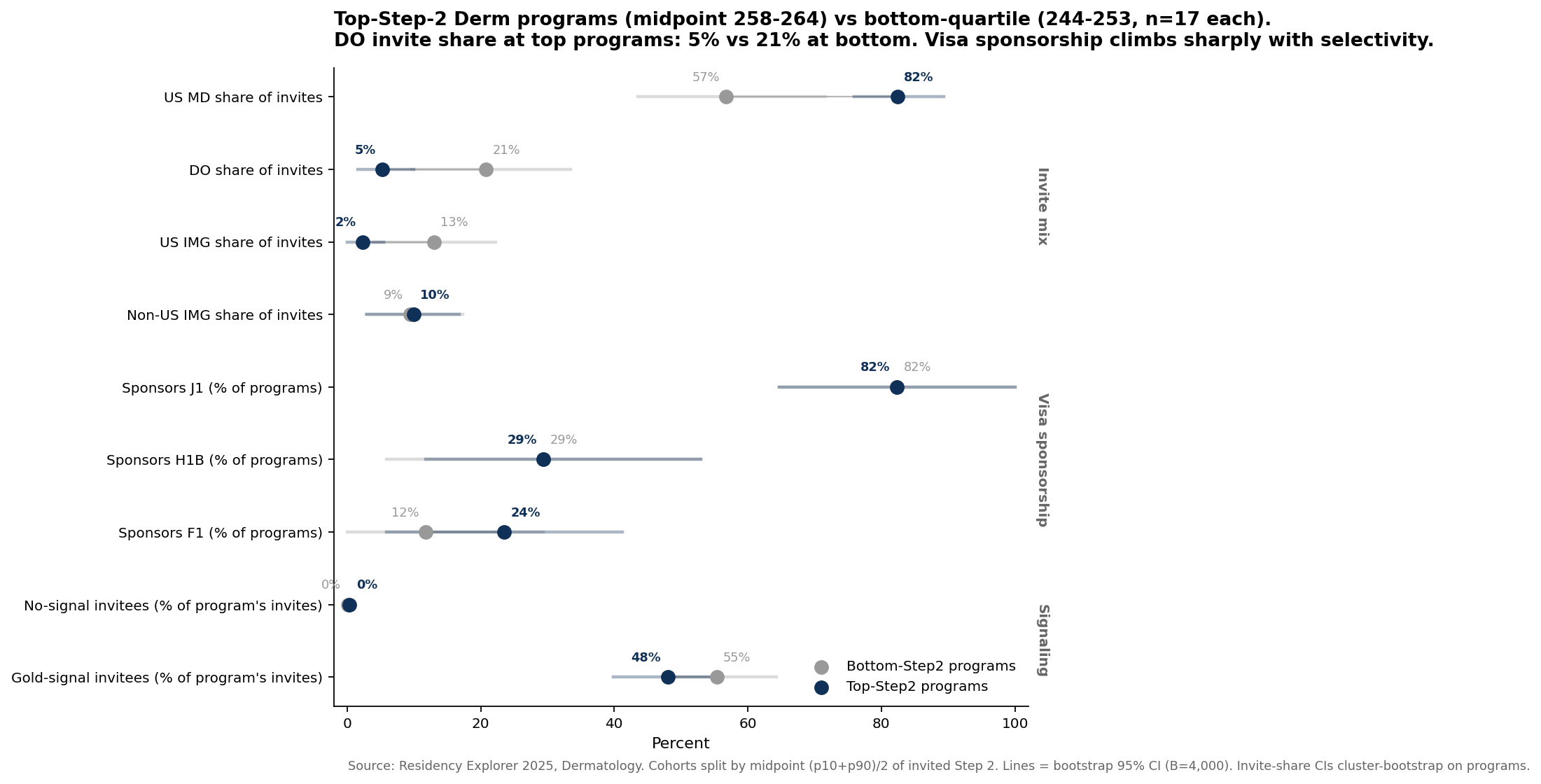
Three things stand out:
- DO invite share collapses at top programs. 21% at bottom-quartile programs, 5% at top. The Step 2 ceiling acts as a filter.
- Visa sponsorship for H1B and J1 is roughly flat across selectivity tiers (29% and 82% respectively). Unlike Internal Medicine, where top programs are markedly more visa-friendly, Derm visa policy does not vary much with program tier.
- F1 sponsorship doubles at top programs (12% vs 24%). Marginal but the only visa flag that varies.
What this means for Derm applicants
- If you do not have an away at a program, signaling is your only path in. At the median Derm program, the data shows essentially no unsignaled invites. Treat your 28 signals as 28 active candidacies, and treat the other ~116 programs as not in play unless you have aways or geographic ties.
- If you have an away rotation, you do not need to signal that program. Your invite probability is already 86%. Use that signal slot on a program where signaling is your only leverage.
- Allocate signals by lift, not by reputation. A signal at a top-tier program with a low USMD share of unsignaled invitees still has a real lift, but a signal at a mid-tier program where your applicant-type and Step 2 band have the highest stratum-level lift will be more efficient. Rezumab's signal strategy explorer ranks all 139 programs by lift for your profile specifically.
- For DO and IMG applicants: the per-program data shows top-quartile Derm programs invite 5% DOs and 2% US IMGs. Even with a perfect signal allocation, top programs are heavily filtered. Bottom-quartile programs invite 21% DOs and 13% US IMGs and are where signal lift has the most room to operate.
- The 47.9% DO and 47.6% IMG match rates are not a verdict on you; they are the bottom line after a brutal sorting process. The strategic question is which programs to signal and which to skip, not whether to apply.
Build your Derm signal strategy
Rezumab's signal-strategy explorer uses applicant-level data from 20,304 Dermatology applicants. Enter your Step 2, applicant type, and home state. We rank all 139 Derm programs by empirical signal lift for your profile, flag programs where signaling is essentially required, and highlight which programs your away rotations make signal-redundant.
Related reading
Methodology & Sources
Signal lift by ties (Finding 1): Rezumab applicant-level data, n=20,304 classifiable Dermatology applicants. Each applicant-program pair is classified by (a) whether the applicant did an away rotation at the program and (b) whether the applicant has a geographic connection (in-state school or geographic-signal area). Invite probability is computed within each cell with and without a program signal. Away-rotation cells have small signaled n (5 each); the within-cell signaling effect there is consistent with no lift but the CI is wide.
Stratum lift (Finding 2): Rezumab signal-lift data, n=139 Dermatology programs, weighted across programs within each Applicant Type x Step 2 band stratum. The 270+ Step 2 band has zero signaled applicants in the dataset and is omitted. DO bands all have signaled n less than 10 and are flagged as too sparse to plot a reliable ratio.
Match rates (Finding 3): NRMP Charting Outcomes 2024 (US MD Seniors, US DO Seniors, and IMG reports), restricted to applicants who ranked Dermatology as their preferred specialty. Match rate is therefore conditional on ranking Derm. Wilson 95% confidence intervals.
No-signal share per program (Finding 4): Residency Explorer 2025 program-reported breakdown of invitee signal status, n=81 Dermatology programs reporting this field.
Applicant / invite / matched share (Finding 5): Applicant and match counts from NRMP Charting Outcomes 2024 (n=553 applicants who ranked Derm); invite counts from Residency Explorer 2025 program-reported invite breakdown (n=1,589 invite-positions across 83 programs reporting type splits). Invite counts are program-reported averages across cycles, not unique-applicant offers.
Top vs bottom Step 2 program contrast (Finding 6): Residency Explorer 2025 Step 2 percentile data, n=68 Dermatology programs with both p10 and p90 reported. Cohorts split on midpoint (p10 + p90) / 2; quartiles (n=17 per cohort). Bootstrap 95% CIs (B=4,000), with invite-share CIs cluster-bootstrapped on programs.
Reproducible analysis: data-don-reports/derm-2026-05-16/ in the Rezumab repo. Companion tables with full sample sizes: tables.md.